How to Grow a Travel Blog Audience From Zero
On this page
I get this question every single week: “How do I grow a travel blog audience when I’m starting from zero?” Here’s the straight answer. Pick two channels that actually send people to your site (for most new travel blogs that’s Google search and Pinterest), publish consistently for at least six months, and grab every visitor you can onto an email list so you own the relationship. Instagram, TikTok and YouTube Shorts build recognition but send very little traffic to a website… treat them as a side dish, not the main course. Below is what actually moves the numbers, what doesn’t, and a weekly time budget so you don’t burn out trying to be everywhere at once.
Key takeaways
- Two traffic channels done properly beat six done badly. For travel, that’s SEO plus Pinterest.
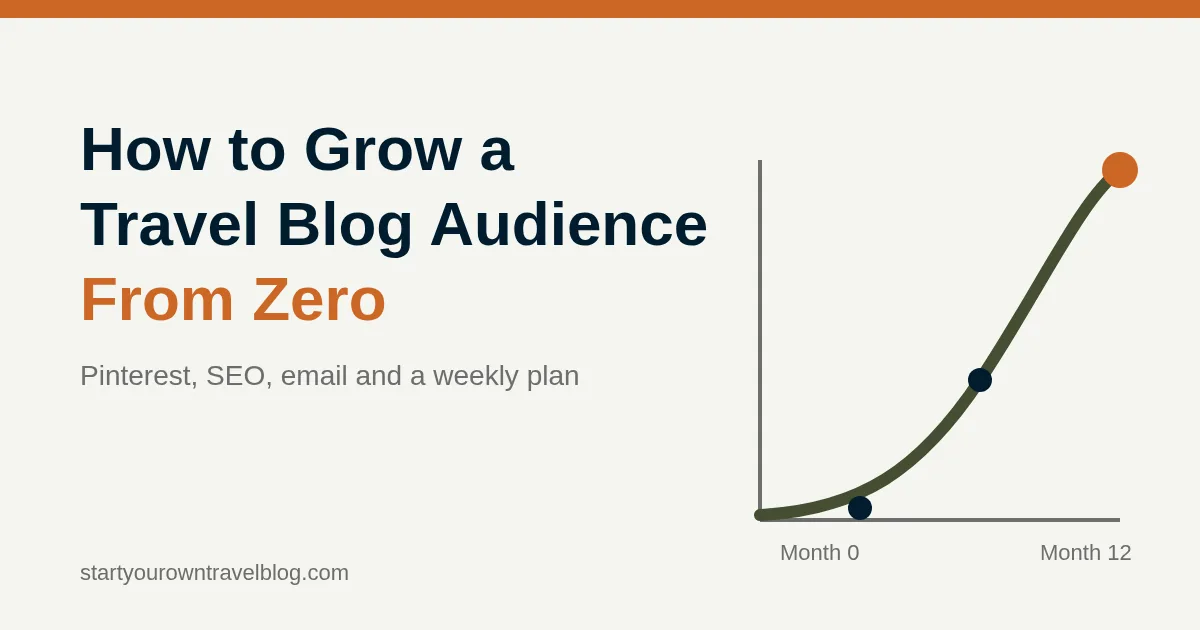
- SEO compounds. Month one looks like nothing; month nine looks like the graph you dreamed about. Do NOT quit at month four.
- Pinterest is a search engine with pictures, and travel is one of its biggest categories. It can send traffic within weeks, not months.
- Start an email list on day one. It’s the only audience an algorithm can’t take off you.
- Short-form video grows followers, not blog readers. Expect low single-digit percentages of viewers to ever land on your site.
- Communities (Reddit, Facebook groups, forums) work when you help first and link rarely. Guest posts and PR requests build links and credibility.
Where does travel blog traffic actually come from?
I’ve peered into the analytics of a LOT of travel blogs over 20 years of building them, from brand-new sites to established ones like Johnny Ward’s onestep4ward.com. The mix varies, but the shape is always the same. Established travel blogs get most of their visits from Google, a decent second slice from Pinterest, a steady trickle from email, and a surprisingly tiny amount from social media… even when the blogger has a big following there.
That shape matters because it tells you where to put your hours. A new blogger’s instinct is to post on Instagram every day because the feedback is instant. And the feedback IS instant. The traffic isn’t. Here’s how the main channels stack up for a new travel blog in 2026.
| Channel | Time to first real traffic | Traffic potential for a blog | Effort per week | Verdict for year one |
|---|---|---|---|---|
| Google search (SEO) | 3–6 months | Very high, compounding | 4–6 hours (writing) | Primary channel |
| 2–8 weeks | High for travel, seasonal | 1–2 hours | Second channel | |
| Email list | Immediate per send, slow to build | Small but loyal, drives repeat visits | 30–60 minutes | Start day one |
| Weeks for followers, referral traffic stays low | Low for clicks, good for brands and credibility | 2–3 hours | Optional, keep light | |
| TikTok / YouTube Shorts | Unpredictable, can spike | Low to medium for clicks, high for reach | 2–4 hours | Only if you enjoy video |
| Reddit, forums, Facebook groups | Days | Low volume, high relevance | 1 hour | Helpful in moderation |
| Guest posts, collaborations | 1–3 months | Indirect (links, authority) | 1–2 hours | One per month |
| PR / journalist requests | Weeks to months | Indirect (links, credibility) | 30 minutes | Cheap upside |
How do I use Pinterest to grow a travel blog?
Pinterest is not social media the way Instagram is. People go there to plan things, and trips are one of the most-planned things on it. A pin you make today can keep sending clicks for two years. For a new travel blog, that makes it the fastest honest source of visitors you’ve got. Not sexy, but it works.
Setup (one afternoon)
- Create a free business account (or convert your personal one) at pinterest.com/business. Claim your website in Settings → Claimed accounts, which switches on analytics and sticks your profile on every pin from your domain.
- Create 8–12 boards named the way people actually search: “Lisbon Travel Tips”, “Portugal Itineraries”, “Europe on a Budget”. Not “Wanderlust ✈”. Please, not that.
- Write a 2–3 sentence keyword-rich description for each board and for your profile.
- In Canva, knock up two or three pin templates at 1000 × 1500 px with big readable text, your site name at the bottom, and space for a photo. Save them; you’ll reuse them for every post from now on.
The routine (1–2 hours a week)
- For every new post, make 2–4 different pins with different photos and titles (“3 Days in Lisbon Itinerary” and “Lisbon on a Budget: What I Spent”).
- Pin them to the most relevant board first, then to one or two others over the following weeks. Pinterest’s own scheduler lets you queue up to two weeks ahead.
- Write pin titles and descriptions the same way you write SEO titles: the destination, the format, and a hook. Add the post’s URL. Fill in the alt text field too.
- Pin seasonally, 6–8 weeks ahead: Christmas markets in October, summer Europe in April.
- Check Pinterest Analytics once a month. Make more pins for the posts getting outbound clicks; ignore impressions, they’re vanity.
One warning: Pinterest traffic is seasonal and can drop off a cliff when the platform fiddles with its feed, so it should be your second channel, never your foundation. Good pins need good photos; if that’s a weak spot, my guide to travel blog photos and free stock covers what to shoot and where to get legal images.
Why is SEO the channel that eventually outgrows everything?
A post that ranks keeps ranking while you sleep, travel, or write the next one. Ten ranking posts send ten streams of traffic; fifty send fifty. Nothing else on this list stacks like that. So what’s the catch? The delay. A new domain typically needs three to six months before Google trusts it enough to show your posts for anything, and most people quit somewhere in that gap. Don’t be most people.
What to actually do about it is all in my travel blog SEO guide for beginners. The short version, for the audience-growth conversation we’re having here:
- Write for questions people type: “where to stay in X”, “X to Y by train”, “is X worth it”. Diary posts don’t rank. Sorry.
- Cluster them. Ten posts on one destination, all linked together, beat ten scattered posts.
- Put your first-hand experience up front: when you went, what it cost, what you’d skip. AI Overviews are eating generic answers; they can’t copy your Tuesday in Porto.
- Set up Search Console in week one so you can see impressions long before you see clicks. Impressions are the early signal that it’s working.
Think of it as two clocks. Pinterest and communities get you visitors in weeks so you stay motivated. SEO gives you the audience that’s still there in year three. You need both clocks running.
Should a brand-new travel blog have an email list?
Yes. From the first week, even if the only subscriber is your mum. Every channel above is rented: Google can roll out an update, Pinterest can change its feed, Instagram can decide your reach is over. An email address is the one thing you actually keep. Email subscribers also come back to read new posts, comment, buy your itinerary later, and forward stuff to friends, which is how tiny blogs get their first “wait, how did they find me?” spikes.
- Pick a free-tier provider (MailerLite, Kit, Brevo and similar offer free plans up to a few hundred or thousand subscribers; check current limits). Hook it up with a simple form plugin or the provider’s own block.
- Offer one specific thing: a printable packing list for your niche, a one-page itinerary PDF, a map of your favorite spots. “Subscribe for updates” converts almost nobody.
- Put the form in three places: the end of every post, the About page, and a sidebar or footer. Skip the full-screen pop-up on mobile; Google penalizes the intrusive ones and readers can’t stand them.
- Send one email a month, minimum. Two lines on what’s new and a link is plenty.
The full setup, including which free plan to pick and a welcome-email template, is in how to build an email list for your travel blog from day one.
Do Instagram, TikTok and YouTube Shorts actually send traffic to a travel blog?
Rarely, and far less than the follower counts would have you believe. All three platforms are built to keep people inside the app. Instagram only allows links in the bio and in Stories; TikTok’s bio link is buried; YouTube Shorts shove viewers straight on to the next Short. From what I see in client analytics, even bloggers with tens of thousands of followers get a small fraction of their site visits from social, often low single-digit percentages. Sound familiar?
That doesn’t make them useless, mind. They do three things well:
- Credibility. Tourism boards and brands look at your Instagram before they look at your analytics. A tidy grid of real photos from real trips makes you look like a real travel blogger, because you are one.
- Reach spikes. One Short or Reel can reach more people in a day than your blog does in a month. A small share follows the bio link; a smaller share subscribes. Small shares of big numbers add up.
- Recycling. A blog post about a train journey becomes a 30-second Short with a “full guide on the blog” caption. You already have the footage; don’t make brand-new content for every platform.
My advice: pick ONE of the three, whichever you’d use anyway, and cap it at two to three hours a week. Post clips from trips you’ve already written about, always point to a specific post, and track clicks with GA4 (set up in my GA4 and Search Console guide) so you know what it’s really sending. If the numbers stay near zero after three months, cut the time in half and give it to Pinterest.
How do I promote a travel blog on Reddit, forums and Facebook groups without getting banned?
Communities are where people ask the exact questions your posts answer, in real time. They’re also where self-promotion gets you booted in minutes. The rule that works everywhere: be the most helpful person in the thread, and only link when the link is genuinely the most helpful thing you can offer.
Etiquette that keeps you welcome
- Read each community’s rules first. Loads of subreddits (r/travel, r/solotravel and most country subs) ban blog links outright; some allow them in weekly threads or when a mod gives the nod.
- Answer the question fully in the comment itself. Paste the actual bus times, the actual price. Then, if it’s genuinely useful, add “I wrote up the whole route with photos here” once.
- Keep a ratio of roughly ten helpful comments for every one link. If your profile is nothing but links, mods and readers both notice.
- Facebook groups for specific destinations (“Portugal Travel Tips”, “Backpacking Southeast Asia”) tend to be more link-tolerant, especially once you’ve been a regular for a few weeks.
- Older forums (Tripadvisor forums, Lonely Planet’s successor communities, country-specific expat forums) still rank on Google. A helpful answer there can send trickles of traffic for years.
- Never post the same link in several places on the same day. It looks like spam because, well, it is.
Here’s a bonus you won’t see in analytics: the questions people ask in these communities are a live keyword research tool. If three people this week asked how to get from Split to Hvar with luggage, that’s your next post. Go write it.
Do guest posts and collaborations still work for travel blogs?
Yes, for two reasons that have nothing to do with the direct traffic, which is usually modest. A guest post on a relevant, real travel site gives you a backlink, which helps your own SEO, and it introduces you to the other blogger, which leads to the next thing. It nearly always leads to the next thing.
- Target the right sites. Blogs slightly bigger than yours in the same region or niche. Not “write for us” pages that accept anything; those links are worth little and can be worth less than nothing.
- Pitch a specific post that fills a gap on their site: “You cover Lisbon well but have nothing on the Setúbal ferry; I did it last month with photos.” Two paragraphs, no attachments.
- Collaborations that work for small blogs: round-up posts (“12 travel bloggers on their favorite Portuguese town”, and every contributor shares it), swapping newsletter mentions, joint Pinterest group boards, and co-hosting an Instagram Live with someone who covers the same place.
- Link to others first. Cite and link the blogs you respect in your own posts, then tell them. Half the time they link back or share it. This is the cheapest link building there is.
- One guest post or collaboration a month is plenty in year one. Your own site needs the writing time more.
How do PR and journalist requests (the old HARO) help a small travel blog?
Journalists writing travel pieces regularly need a quote from “someone who has done X.” Services collect those requests and email them to you; you reply, and if they use your quote you get a mention and often a link from a big publication. HARO, the original service, shut down in late 2024 and was relaunched by a new owner in 2025; the landscape now includes several similar tools, such as Qwoted, Featured, and Source of Sources, most with free tiers. Availability and terms change often, so check what’s current when you sign up.
- Sign up for one or two services and filter for travel. Expect a handful of relevant requests a week.
- Reply within an hour or two where you can; journalists take the first good answers and move on.
- Answer the question in three or four quotable sentences, add one line on who you are and your URL, and stop. No pitch, no attachments.
- Only answer what you genuinely know. “I’ve crossed that border twice” is worth more than a generic tip, and it’s the whole point of the exercise.
- Also follow #journorequest on X and Bluesky, where requests show up before they hit the email digests.
Realistic hit rate: perhaps one placement per 10–20 replies. Sounds rubbish until you notice that each one is a link most bloggers never get, plus a line on your About page (“featured in…”) that tourism boards take seriously.
How many hours a week does it take to grow a travel blog?
Most people building a blog around a job or studies have eight to twelve hours a week. Here’s how I’d split it for the first year. Writing gets the biggest chunk because everything else depends on having something worth sending people to.
| Activity | Hours / week (10-hour plan) | What “done” looks like | Skip it if… |
|---|---|---|---|
| Writing and updating posts (SEO) | 5 | One new post or one major update per week, with photos, tables, internal links | Never skip |
| 1.5 | 2–4 pins per new post, scheduled; monthly analytics check | Your niche is B2B or very local | |
| 0.5 | Sign-up form live; one short email per month | Never skip, it is 30 minutes | |
| One short-form video platform | 1.5 | 2–3 clips recycled from existing posts, each pointing to a post | You dislike video; move the time to Pinterest |
| Communities (Reddit, groups, forums) | 1 | 10 helpful answers, at most 1 link | You cannot resist over-linking |
| Outreach: guest post, collab or PR replies | 0.5 | One pitch or 2–3 journalist replies | Nothing relevant that week |
Only got five hours? Keep writing at three, Pinterest at one, email at half an hour, and drop everything else. And if you’re not traveling right now and worried you’ve got nothing to write about, how to run a travel blog when you’re not traveling has a list of post types you can write from your desk using trips you’ve already taken.
What I’d do differently: mistakes I see in the first year
- Being everywhere. Six platforms at 20% effort each grows nothing. Two channels, done every week, do.
- Measuring followers instead of visits. Followers are a vanity metric for a blog. Open GA4, look at sessions by source, and put your time where the visits are actually coming from.
- Quitting in month four. That’s exactly when SEO is about to turn. Decide up front that you’ll judge the blog at month twelve and not a day sooner.
- Starting the email list “when there’s traffic”. The visitors you get in months one to six are gone forever if there’s no form.
- Buying followers, group-board schemes, or link packages. None of it converts, some of it gets you penalized, and brands can spot fake engagement a mile off.
- Promoting before the About page exists. Every new visitor who likes a post clicks About. If it’s empty, they leave. Use the About page template before you start any outreach.
- Writing what you feel like instead of what people search for. You can do both, but the searchable posts pay for the diary posts, not the other way round.
Growing an audience from zero is mostly a patience problem dressed up as a marketing problem. Publish something useful every week, put it where the planners are looking, collect emails, and keep going past the point where it feels like nothing’s happening. Because that’s exactly the point where it starts. If you’re still at the “I don’t even have a blog yet” stage, the 7-step guide on the homepage will get you one this weekend.
And if you get stuck anywhere along the way, seriously, just ask. I’ve built 200+ of these and I’ve watched which ones grow and which ones fizzle, so there’s a decent chance I’ve seen your exact problem before. Drop me a message through the contact page and I’ll help you out, for free. That’s not a sales pitch, it’s just how I got started myself. Now go publish something. You can do this.
Frequently asked questions
How long does it take to grow a travel blog audience?
Expect Pinterest to send your first visitors within a few weeks, Google to start showing impressions around month three to six, and the blog to feel like it has a real audience somewhere in the second half of year one. That assumes one useful post a week, every week.
Is Pinterest still worth it for travel bloggers in 2026?
Yes, absolutely. Travel is one of Pinterest's biggest planning categories, and pins keep sending clicks for months or even years. It's seasonal and can wobble when the platform changes things, so treat it as your second channel behind SEO, not your foundation.
Does Instagram drive traffic to a travel blog?
Very little, honestly. Links are limited to the bio and Stories, and the app is built to keep people inside it. Instagram is brilliant for credibility with brands and tourism boards, not for blog visits. Cap it at a couple of hours a week and move on.
Can I promote my travel blog on Reddit?
Carefully. Loads of travel subreddits ban blog links outright. Answer the question fully in the comment, keep roughly ten helpful comments for every link, and only link when your post genuinely is the best answer. Facebook destination groups and older forums tend to be more tolerant.
How many hours a week do I need to grow a travel blog?
Ten hours a week is comfortable: about five on writing, one and a half on Pinterest, one and a half on one video platform, one on communities, and half an hour each on email and outreach. Only got five? Keep writing, Pinterest and email, and drop the rest.
What replaced HARO for getting featured in travel articles?
HARO shut down in late 2024 and was relaunched under new ownership in 2025; similar services with free tiers include Qwoted, Featured and Source of Sources, plus #journorequest on X and Bluesky. Reply fast, only answer what you've actually done, and expect roughly one placement per 10–20 replies.
Should I start an email list before I have traffic?
Yes, in week one. The visitors you get in your first few months are gone forever if there's no sign-up form waiting for them. Free plans from MailerLite, Kit or Brevo are plenty to start; offer something specific like a packing list or a one-page itinerary.
Some links in this guide are affiliate links. If you buy through them I earn a commission at no extra cost to you, which keeps the free help free. Full disclosure.
Keep going
Travel Blog SEO for Beginners: How to Get Found on Google
Travel blog SEO explained by a developer who's built 200+ blogs: what to write, how to research it for free, how to cluster it,…
How to Build a Travel Blog Email List From Day One
Your email list is the only audience nobody can take off you. Here's how I'd start one for free on day one: which provider,…
How to Install WordPress on Bluehost (Step by Step, 2026)
Bluehost installs WordPress for you at signup, so here's the current 2026 flow, where wp-admin is hiding, how to install on any other host,…
Questions & answers
Entries tagged “Common question” are questions beginners ask me all the time; I’ve added them here with my answers. Everything else is from readers. Got one of your own? Ask at the bottom and I’ll reply.
Common question
My own travel photos are pretty average. Is it OK to use free stock photos on my Pinterest pins instead?
Aghosh Babu Author
For pins, yes. A pin’s job is to stop the scroll and get the click, and the big readable text overlay does more of that work than the photo behind it. Grab images from the free stock sites, check the license lets you use them commercially, and drop them into your Canva template. Just don’t pick the same sunset everyone else has used. Inside the blog post itself it’s a different story: that’s where your own photos matter, even the average ones, because they prove you were there. A slightly wonky shot of the actual ferry beats a gorgeous stock one. Where to find legal free images is in my guide to travel blog photos and free stock.
Common question
Two of my posts get nearly all my traffic and the other twenty get almost nothing. Do I write more like the two winners or try to fix the dead ones?
Aghosh Babu Author
More like the winners. First thing, though: that split is completely normal. On nearly every blog I’ve looked after, a handful of posts carry the lot. So squeeze those two. Write three or four new posts on closely related questions and link them both ways. Put your email sign-up form inside both posts, because that’s where your visitors actually are. Make a few extra pins for each. As for the quiet twenty, don’t rewrite them all. Open Search Console and look for any sitting at position 8–20 with decent impressions; those are worth an update. The rest can wait. How to read that report is in my GA4 and Search Console setup guide.
Common question
My blog only has three posts so far. Is it too early to bother with Pinterest, or should I wait until I’ve got more to pin?
Aghosh Babu Author
Set it up now, keep it small. The setup is a one-off afternoon: business account, claim your site, a handful of boards, two or three pin templates in Canva. Better to do it while the blog is small than to bolt it on at post 30. Then make 2–4 pins for each of your three posts and spread them over a couple of weeks. That’s roughly ten pins. Not a lot, and that’s fine. What you’re really building is the habit: every new post gets its pins the week it goes live. Don’t pad your boards with hours of other people’s content to look busy. Writing post number four will do more for you than that ever will. So: an hour a week, max, for now.
Common question
Is it worth paying for Facebook or Pinterest ads to get my first visitors? I could spare maybe $50 a month.
Aghosh Babu Author
Keep your $50. Paid visitors stop the second you stop paying, and a new blog earns a few cents per visitor at best, so you’d be buying traffic for more than it could ever earn you back. There’s nothing to “kick-start” either: Google doesn’t rank you higher because an ad sent people over. The channels that grow a blog in year one all cost time, not money. One post a week, a few pins per post, one email a month. If that $50 is burning a hole in your pocket, it’s better spent on your hosting renewal. Want to see what a visitor is realistically worth at each stage? It’s all in how travel blogs make money, ranked by realism.